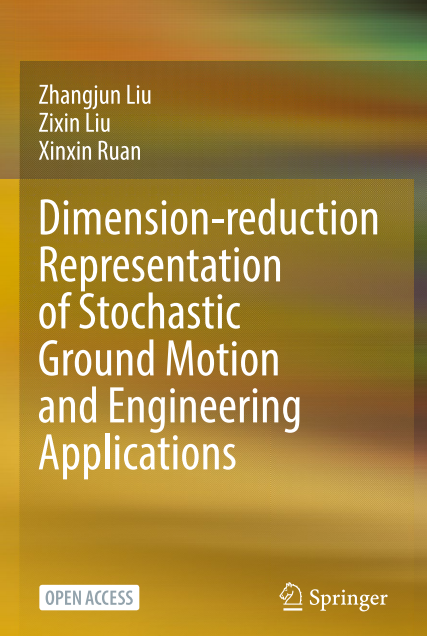
Research Team Led by Professor Zhangjun Liu Publishes an English-Language Monograph with Springer
Recently, the English-language academic monograph Dimension-reduction Representation of Stochastic Ground Motion and Engineering Applications, edited by Professor Zhangjun Liu of the School of Civil Engineering and Architecture at Wuhan Institute of Technology, was officially published by Springer, an internationally renowned academic publisher. The book comprises eight chapters and 295 pages and is published as an open-access volume, with the full text freely available for download to readers worldwide. This will help promote the international sharing and global dissemination of original research achievements in China’s earthquake engineering field.
The monograph embodies more than a decade of sustained research by Professor Zhangjun Liu’s team. It systematically establishes a theoretical framework for the dimension-reduction representation of stochastic seismic actions, together with a suite of efficient simulation methods. It also presents innovative applications of full-probability modelling of seismic actions to refined nonlinear stochastic seismic response analysis and seismic reliability assessment of complex engineering structures. By integrating fundamental theoretical innovation with the practical needs of major engineering projects in disaster prevention and mitigation, the monograph brings together stochastic ground-motion modelling theory and its application to seismic analysis of complex engineering structures. It represents a significant academic achievement in stochastic ground-motion modelling, combining cutting-edge theoretical value with substantial engineering relevance, and offers a Chinese approach of reference value to the international earthquake engineering and structural seismic research communities.
The main innovations and distinctive features of the monograph are as follows:
(1) Establishment of a unified theory of dimension-reduction representation. The monograph elucidates the physical essence of dimension reduction in high-dimensional stochastic dynamical systems and establishes a unified theoretical framework for the dimension-reduction representation of stationary and non-stationary stochastic processes and random fields, based on both frequency-domain and time-domain analytical methods.
(2) Development of a full-probability modelling method. The dimension-reduction representation theory is essentially a full-probability modelling method and is inherently consistent with the “third-generation structural design theory,” including the probability density evolution theory. It can therefore be integrated with these theories to facilitate refined nonlinear dynamic response analysis and reliability assessment of complex engineering structures throughout their entire service life.
(3) Simulation of various types of ground motion. The methods enable dimension-reduction modelling of various stochastic seismic actions, including fully non-stationary ground-motion stochastic processes in the time and frequency domains with a single random variable (1D-1V) or multiple random variables (1D-nV), as well as continuous spatiotemporal random fields (mD-1V).
(4) Integration of theory and engineering applications. The effectiveness and engineering applicability of the dimension-reduction ground-motion modelling methods are demonstrated through nonlinear stochastic seismic response analysis and seismic reliability assessment of representative engineering structures, including concrete gravity dams, high-rise frame-core tube structures, and high-pier, long-span continuous rigid-frame bridges.
Publication Details